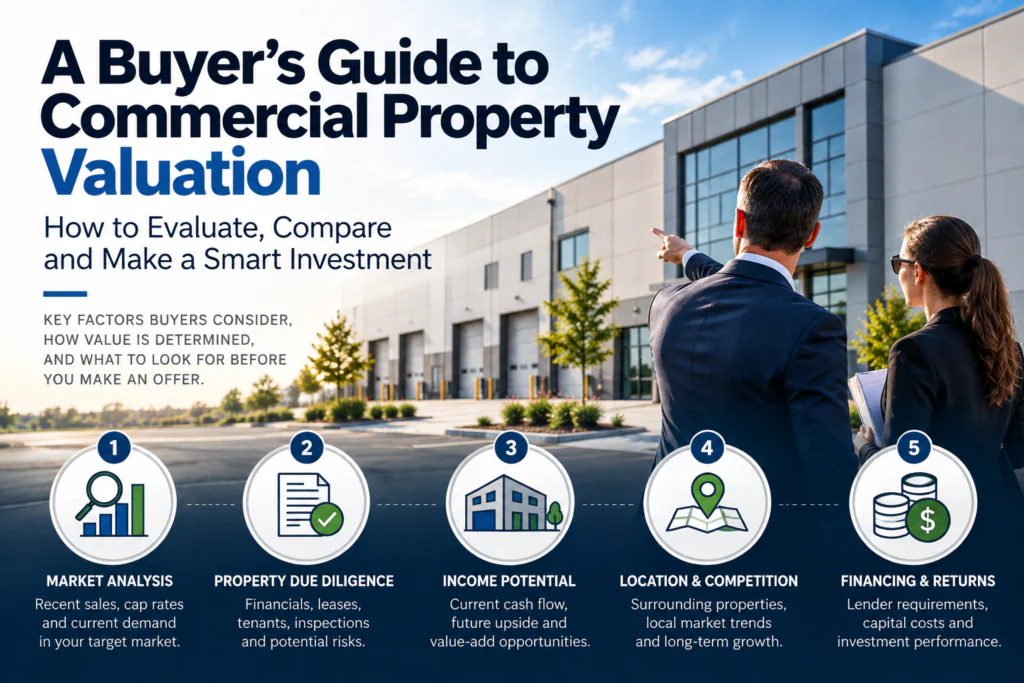
A commercial property due diligence checklist is the list of records, inspections and calculations a buyer completes before closing to confirm what a building is worth and what it will cost to own. A building is worth what its income and its comparable sales support, minus what it will cost to fix, re-lease and finance.
I started my career at CBRE and was the first broker hired at Massey Knakal. Over roughly 30 years of commercial real estate, the deals that went wrong for buyers rarely failed on price alone. They failed on a roof nobody priced, a lease nobody read, or a zoning text nobody pulled. This checklist is the one I use to value a building on the buy side, organized so you can work through it during your due diligence period.
How to Use This Commercial Property Due Diligence Checklist
Every item below answers three questions: what to check, what counts as a red flag, and how it moves the price.
- Rate each item Good (no action), Watch (budget within five years) or Fix (budget now, or price it in).
- Put a cost estimate on every Watch and Fix item. The total becomes your rehab budget and comes off your offer price.
- Log each fact with its source and the date you read it. If you can't verify a fact, write down the document that would close it.
Service-life figures below are typical industry ranges. They are approximate; climate and maintenance move them.
Step 1: Define Your Buyer Strategy Before Buying a Commercial Building
The same building is worth different amounts to different buyers. Decide which buyer you are before you inspect.
| Buyer strategy | What drives value | What to weigh most |
|---|---|---|
| Owner-user | Avoided rent, fit for the business, SBA financing | $/SF comps, condition, layout, occupancy rules |
| Core investor | In-place NOI, credit tenants, long leases | Leases, rollover, cap rate |
| Value-add | Lease-up, rent growth, renovation | Market rent, rehab cost, vacancy |
| Redevelopment | Land, zoning, what can be built | Zoning, site, demolition, entitlements |
Documents to request from the seller on day one
- Rent roll, signed leases and amendments, tenant estoppels
- Two to three years of operating statements, plus the current year to date
- Latest tax bill and any open tax appeals
- Twelve months of utility bills
- Service contracts: HVAC, elevator, landscaping, waste, security
- Existing survey, title policy, prior appraisals and environmental reports
- Permits, certificates of occupancy, roof and HVAC warranties
- Capital spending history: what was replaced, when, by whom, at what cost
- Floor plans and any as-built drawings
- Open violations, insurance claims and litigation disclosures
Step 2: Title Search and Lien Review
A title problem can stop the sale or the loan. Clear these items before you spend money on inspections.
| Item | What to check | Red flags | Value impact |
|---|---|---|---|
| Ownership | Owner of record matches the seller; entity has authority to sell | Different entity, an estate, or several owners | Delay or no deal |
| Address and parcel | Address resolves to one parcel; legal description matches the survey | Tax account under a different address; split or combined lots | Re-survey; possible area change |
| Liens and mortgages | Title commitment: mortgages, mechanics' liens, judgments, tax liens | Recent contractor liens (unpaid work) | Paid at closing or deducted |
| Lis pendens and litigation | Court records against the owner and parcel | Pending suits or foreclosure filings | Deal risk; escrow holdback |
| Easements and encroachments | Survey and title exceptions | Shared driveway; utility easement under the building; structures over the line | Limits use, expansion or financing |
| Code violations | City code compliance and building department | Open cases or unsafe-structure orders | Cost to cure; fines |
| Tax status | Taxes paid; reassessment on sale | Delinquency; large step-up after the sale | Higher expense, lower NOI |
| Historic designation | City or state register | Designated building or district | Limits on facade, windows, demolition; possible tax credits |
| Deed history | Prior sales and prices where disclosed | Frequent flips; non-arm's-length transfers | Weak price support |
Step 3: Zoning Verification and Rehab Potential
Zoning sets the ceiling on what the building can earn. Read the ordinance text; a zoning code alone is not enough.
| Item | What to check | Red flags | Value impact |
|---|---|---|---|
| Zoning district | Code, ordinance number, permitted and conditional uses | Planned development or overlay with unread text | Your use may not be allowed |
| Current use | Certificate of occupancy matches actual use | No CO; use changed without permits | Cost and time to legalize |
| Conformity | Is the building legal nonconforming (grandfathered)? | Rights lost if vacant or destroyed | Lender may cap the loan; rebuild risk |
| Parking requirement | Required spaces vs. actual | Short of required parking | Blocks a change of use or tenant |
| Buildable area | FAR, height, setbacks, lot coverage vs. what exists | Building already over limits | No expansion upside |
| Unused development rights | Remaining FAR or air rights | — | Upside: addition or sale of rights |
| Rehab potential | A higher-value use is allowed (office to medical, retail to restaurant, conversion to residential) | Use change triggers a full code upgrade: sprinklers, ADA, egress | Upside, but price the code cost |
| Highest and best use | As-is vs. renovated vs. land value | Land worth more than the building | Valued as land; building is a teardown |
| Permit history | Open, expired or unfinaled permits | Work done without permits | Must permit or remove |
Closes it: a zoning verification letter from the city and the certificate of occupancy from the building department.
Step 4: Commercial Lease Review — Tenants, Terms and Occupancy
For an investor, the leases are the asset. Verify every number on the rent roll against a signed lease.
| Item | What to check | Red flags | Value impact |
|---|---|---|---|
| Occupancy | Physical and economic occupancy; SF leased vs. vacant | Tenants in place but not paying; owner-affiliated tenants | Lower NOI, higher vacancy |
| Lease type | Gross, modified gross or NNN; who pays taxes, insurance, CAM, utilities | Gross leases with rising expenses | Expense growth comes out of NOI |
| Rent vs. market | In-place $/SF vs. market rent | Above-market rents expiring soon | Rent rolls down at renewal |
| Lease term and rollover | Expiration dates; share of rent expiring each year | Over 30% of rent expiring within two years | Re-leasing cost and vacancy |
| Renewal and termination options | Option rents, early-termination rights | Cheap options or early outs | Caps upside; adds risk |
| Escalations | Fixed bumps or CPI | Flat rent over a long term | Below market by the end |
| Tenant credit | Financials, guarantees, payment history, arrears | Single tenant with a weak or no guarantee | Higher cap rate |
| Concessions | Free rent, TI allowances owed, unpaid commissions | Obligations that survive the sale | Credit to buyer at closing |
| Security deposits | Amounts held | Missing or commingled | Must transfer at closing |
| Rights on sale | Tenant right of first refusal or first offer | A ROFR that can take the deal | Deal risk |
| Estoppels | Signed by each tenant | Tenant disputes rent or claims defaults | Re-price or walk |
| Owner-user space | SF you will occupy; existing leases to honor | Can't free up 51% for an SBA loan | SBA route closes |
Step 5: Building Systems Inspection — Electrical, HVAC and Plumbing
Systems are the most expensive surprises after the roof. Get ages from data plates and permits, not from the seller's memory.
| Item | What to check | Red flags | Value impact |
|---|---|---|---|
| Electrical service | Amps, voltage, single- vs. 3-phase; panel brand and age | Undersized service; obsolete or recalled panels | Upgrade cost; limits tenants |
| Wiring | Copper vs. aluminum; knob-and-tube; grounding | Aluminum branch wiring or knob-and-tube | Rewiring cost; insurance problems |
| Metering | One meter or one per suite | Owner pays all electricity on gross leases | Higher expenses; submetering cost |
| HVAC type | Rooftop units, split systems, boiler/chiller; zones per suite | One system for several tenants | Tenant complaints; costly to split |
| HVAC age and condition | Install date, refrigerant type, service records | Units past about 15 years (typical life roughly 15–20); R-22 refrigerant | Replacement budget |
| Plumbing | Supply pipe material, drain lines, water heater age | Galvanized supply, cast-iron drains, polybutylene, lead | Repipe cost; leaks |
| Sewer lateral | Camera scope to the main | Root intrusion, collapse, offset joints | Excavation and repair |
| Fire and life safety | Sprinklers, alarm, exit lights, inspection tags | No sprinklers where a use change requires them; expired inspections | Code cost on renovation |
| Accessibility (ADA) | Entrance, restrooms, parking, path of travel | No accessible entry or restroom | Required on renovation; lawsuit exposure |
| Elevators | Capacity, age, last inspection | Expired certificate; original equipment | Modernization cost |
| Hazardous materials | Asbestos and lead paint in pre-1980 buildings | Damaged or untested suspect materials | Abatement before renovation |
Step 6: Commercial Roof Inspection, Facade, Windows and Doors
The envelope keeps water out. Most interior damage traces back to a failed roof, gutter, sealant joint or window.
Commercial roof types and typical service life
| Roof material | Typical service life (approx.) | What to look for |
|---|---|---|
| Asphalt shingle | 20–30 years | Curling, granule loss, missing shingles, multiple layers |
| Metal (standing seam, panel) | 40–60 years | Rust, loose fasteners, failed seams and sealant |
| TPO or PVC membrane (flat) | 20–30 years | Seam separation, punctures, shrinkage at edges |
| EPDM rubber (flat) | 20–30 years | Seam failure, blistering, ponding |
| Modified bitumen | 15–25 years | Cracks, blisters, open laps |
| Built-up (tar and gravel) | 20–30 years | Bare spots, blistering, ponding |
| Tile or slate | 50+ years | Broken or slipped units, failed flashing |
Roof, gutter and drainage checklist
- Roof age from the permit or warranty; is the warranty transferable?
- Number of layers; a second overlay usually means a full tear-off next time
- Ponding water, soft decking, flashing at walls, curbs and penetrations
- Rooftop equipment curbs and supports
- Gutters and downspouts: size, attachment, rust, leaf guards
- Downspouts discharge away from the foundation, not onto walkways
- Roof drains and scuppers clear on flat roofs
- Ceiling stains inside, under the roof
Facade types: masonry, EIFS, stucco, plaster, metal and glass
| Facade type | Common failures | What to check |
|---|---|---|
| Masonry (brick, block, stone) | Mortar erosion, spalling, cracks, rusted steel lintels, efflorescence | Repointing needs, step cracks (settlement), lintel condition |
| EIFS | Water trapped behind the system, sheathing rot, impact damage | Moisture probes at windows and joints; drainage-type or barrier-type system |
| Stucco | Cracking, bulging, water intrusion at openings | Crack pattern, stains below windows, moisture testing |
| Plaster | Cracks, delamination, hollow spots | Tap test, water staining |
| Metal panel | Corrosion, failed sealant joints, loose fasteners, dents | Joints and fastener lines, oil-canning |
| Glass and curtain wall | Failed seals (fogged units), gasket failure, leaks | Fogged panes, staining at mullions, date of last resealing |
Windows and doors
| Item | What to check | Red flags | Value impact |
|---|---|---|---|
| Windows | Frame material, single vs. double pane, operable units | Single-pane glass, rotted frames, fogged units, failed caulk | Replacement and energy cost |
| Storefront | Aluminum storefront, glazing, hardware | Leaks, cracked glass, worn closers | Repair or replace |
| Entry doors | Material, closers, locks, ADA hardware | No ADA-compliant entrance | Required on renovation |
| Rear and service doors | Steel doors and frames, panic hardware | Rusted frames; missing panic hardware on exits | Fire code issue |
| Overhead and roll-up doors | Size, operator, springs, seals | Damaged panels; no operator | Limits loading use |
Step 7: Interior Inspection — Flooring, Subfloor, Basement Moisture, Bathrooms and Kitchens
The interior shows how the building has been maintained and what a prospective tenant will see on a tour.
| Item | What to check | Red flags | Value impact |
|---|---|---|---|
| Structure | Foundation type (slab, crawlspace, basement); framing (steel, wood, concrete) | Cracks wider than 1/4 inch, doors out of square, sloping floors | Structural engineer; possibly major repair |
| Flooring | Carpet, VCT, LVT, tile, polished concrete or wood; wear | 9×9 tile (possible asbestos); worn carpet in common areas | Replacement before leasing |
| Subfloor | Soft spots, deflection, water damage; slab cracks and level | Rot near restrooms or entries; heaving slab | Subfloor repair under new finishes |
| Basement | Use, ceiling height, egress, finish | Occupied space without egress or permits | Can't count as rentable |
| Moisture | Stains, efflorescence, musty odor, moisture-meter readings, sump pump | Standing water, active mold, failed sump | Waterproofing and remediation |
| Ceilings and walls | Drop-ceiling tiles, drywall, plaster | Stained tiles (active leaks above) | Trace to roof or plumbing |
| Bathrooms | Count per floor, fixtures, ventilation, ADA stall | Too few for the occupancy load; no accessible restroom | Renovation for code or tenants |
| Kitchens and break rooms | Cabinets, counters, appliances, venting; grease trap for food use | Unpermitted cooking; no hood where required | Upgrade cost; limits restaurant tenants |
| Storage | Amount, location, access, climate | None, or only in a damp basement | Lower tenant appeal |
| Common areas | Lobby, corridors, stairs, lighting | Dated finishes at first impression | Lower rents until refreshed |
| Pests | Termites, rodents, insects | Active infestation; wood damage | Treatment and repair |
Step 8: Site Inspection — Driveway, Parking, Rear Access, Landscaping and Signage
The site decides how tenants and customers reach the building, and how water leaves it.
| Item | What to check | Red flags | Value impact |
|---|---|---|---|
| Driveway and parking surface | Asphalt or concrete; cracking, potholes, sealcoat, striping | Alligator cracking, standing water, trip hazards | Resurface or replace; liability |
| Parking count | Spaces vs. zoning requirement and tenant need; ADA spaces | Too few spaces; no accessible spaces | Limits tenants; ADA exposure |
| Ingress and egress | Curb cuts, turning room, shared access agreements | Access over a neighbor's lot without an easement | Title issue; lost access |
| Rear access | Alley or rear drive, rear doors, delivery space | No rear access for service or deliveries | Limits retail and industrial use |
| Site drainage | Grading away from the building, catch basins, retention | Water flowing toward the building; clogged basins | Foundation and moisture problems |
| Landscaping | Condition, irrigation, trees near the building | Roots near the foundation or sewer line; overgrowth | Low cost, but affects first impression |
| Signage | Pylon, monument and building signs; who controls them | No sign rights; nonconforming pylon that can't be replaced | Lower retail and office appeal |
| Lighting and security | Exterior lighting, cameras | Dark parking lot | Tenant safety; insurance |
| Fencing and dumpster enclosure | Condition and location | Fence over the property line | Survey issue |
| Visibility and traffic | Frontage, traffic counts, corner location | Hidden from the main road | Lower retail rent |
Step 9: Phase I Environmental and Flood Zone Review
Most lenders require a Phase I Environmental Site Assessment. Order it early; a finding that calls for Phase II testing can change or end the deal.
| Item | What to check | Red flags | Value impact |
|---|---|---|---|
| Phase I ESA | Past uses of the site and its neighbors | Former gas station, dry cleaner, auto repair or manufacturing | Phase II testing; cleanup cost |
| Underground storage tanks | Records, fill pipes, vent pipes | Abandoned tank not removed | Removal and soil testing |
| Nearby listed sites | EPA Superfund and brownfield sites within one mile | Contamination upgradient | Lender caution; lower value |
| Flood zone | FEMA flood map; lender flood determination | High-risk zone (A or V) | Required flood insurance; lower NOI |
| Wetlands | Wetlands mapping near the site | Wetlands on the lot | Limits expansion and paving |
| Radon and mold | Testing where relevant | Elevated levels | Mitigation cost |
"No record found" is not the same as clean. Log which sources answered and which did not.
Step 10: How to Value a Commercial Property — Comps, Income Approach and Cap Rate
A commercial property's value comes from two approaches, reconciled: what comparable buildings sell for, and what the building's net operating income supports at a market cap rate. The condition findings from Steps 5 through 9 then come off as a rehab budget.
Property records
- County account, owner, legal description, building SF, land SF, year built, county depreciation
- Assessed value and its history; taxes checked against the combined tax rate
- Area check: county SF vs. other records vs. survey, with the value shown at each
Sales comparison approach
- Five or six comparables of the same type and similar size, nearest first, with listing or MLS numbers
- Label each comparable closed, under contract or asking, and discount asking prices
- Adjust for size, age and condition, and location
- List the comparables you excluded and why
- Check whether your state discloses sale prices; Texas and other non-disclosure states do not
Income approach and cap rate
- Use the actual rent roll; without one, label the analysis a market-rent pro forma
- Lease comparables with their lease basis (gross or NNN)
- Pro forma: gross income, vacancy, effective income, itemized expenses, NOI
- Re-underwrite expenses: taxes reassessed after the sale, a current insurance quote, a management fee even if the seller self-manages, reserves
- Cap rate chosen from a stated range of sourced cap rates, with any premium for age or tenancy explained
- Sensitivity grid: market rent × cap rate
Reconciling the value range
- Weight the approaches by who buys this building: owner-users price by $/SF; investors price on income
- State the value range, midpoint and $/SF at each edge
- As-is value minus your rehab budget equals what you can pay
- Compare the result to the asking price, the assessed value and the last recorded sale
Example: on a 4,960 SF, 1958 multi-tenant office building in Richardson, Texas, comparables carried 75% of the weight and income 25%, because small office buildings there are bought mostly by owner-users. Without a rent roll, the income value moved from about $341,000 to $842,000 across the rent and cap-rate grid. That is why the rent roll is the first document to request.
Step 11: Rehab Budget and Capital Expenditure Plan
Every Watch and Fix rating becomes a line in this table. The "now" column comes off your offer price; the five-year column sets your reserves.
| Category | Rating | Cost now ($) | Cost within 5 years ($) | Source of estimate |
|---|---|---|---|---|
| Roof | ||||
| Facade | ||||
| Windows and doors | ||||
| HVAC | ||||
| Electrical | ||||
| Plumbing and sewer | ||||
| Fire, life safety and ADA | ||||
| Interior finishes | ||||
| Bathrooms and kitchens | ||||
| Basement and moisture | ||||
| Site, paving and drainage | ||||
| Environmental | ||||
| Tenant improvements and leasing commissions | ||||
| Contingency (10–15% of total) |
- Renovation history: what was replaced, the year, contractor, permit and warranty
- Contractor bids for any item over your threshold
- A property condition assessment (PCA) to confirm or replace these estimates
- Code upgrades triggered by your planned renovation or use change
Step 12: Commercial Property Financing — LTV, DSCR and SBA Loans
The loan, not the appraisal, often sets the real price ceiling. Size it on the building's NOI before you make an offer.
- Current rates with source and date: bank owner-occupied, bank investor, SBA 504 and SBA 7(a)
- Loan limits at 70%, 75% and 80% loan-to-value vs. 1.25x debt-service coverage; note which one binds
- Rate shock: loan size if rates rise one percentage point
- Equity required, including closing costs, for each route
- SBA route for owner-users: up to 90% financing, 51% owner occupancy, and the business cash flow needed to reach 1.25x
- Cash flow in years 1, 3 and 5: NOI growth, debt service, DSCR, cash-on-cash return
- How the rehab budget is funded: equity, a renovation loan or a lender holdback
- Exit: sale value at an exit cap rate in year 5 or 10, and total return
- Owner-users: compare the total cost of owning to the rent the business would otherwise pay
Step 13: Go or No-Go — Documents That Close Due Diligence
Before your due diligence period ends, every open item is either closed by a document or priced into your offer.
| Open question | Document that closes it |
|---|---|
| Actual rents, expenses, tenant disputes | Rent roll, leases, operating statements, estoppels |
| Building and lot area; encroachments | ALTA survey |
| Condition and capital needs | Property condition assessment; roof, HVAC and sewer inspections |
| Allowed uses and parking | Zoning verification letter; certificate of occupancy |
| Liens, judgments, lis pendens | Title commitment |
| Open code cases and permits | City code compliance and building department |
| Contamination | Phase I ESA (Phase II if flagged) |
| Flood zone | Lender flood determination |
| Market value | Appraisal with closed-sale data |
| Loan amount | Lender term sheet |
When to walk away or re-price
- Title can't be cleared, or a tenant holds a right of first refusal that takes the deal
- Your planned use isn't allowed, or needs a variance you can't get
- Environmental findings call for remediation
- Rehab budget plus price exceeds the as-renovated value
- The loan sized on NOI leaves more equity in the deal than it can return
Due Diligence Checklists by Property Type
The thirteen steps above apply to every commercial building. These checklists add the items that change value for each property type.
Office building due diligence
Office value turns on tenant fit: layout, parking, systems per suite and the cost to re-lease.
| Item | What to check | Red flags | Value impact |
|---|---|---|---|
| Class and age | Class A, B or C; renovations since built | Class C in a high-vacancy submarket | Higher cap rate; longer lease-up |
| Rentable vs. usable area | BOMA measurement; load factor | Rent roll SF that doesn't match plans | Rent and value overstated |
| Suite layout | Divisible suites, window line, column spacing, depth | Deep, dark floor plates; single-tenant layout | High TI cost to re-lease |
| Parking ratio | Spaces per 1,000 SF vs. the submarket norm | Below market ratio | Lower rents; limits medical use |
| HVAC per suite | Separate zones and thermostats; after-hours HVAC | One system for all tenants | Complaints; costly split |
| Elevators and restrooms | Count, age, inspection; multi-tenant restrooms per floor | Single elevator; restrooms only inside one suite | Modernization or re-leasing problem |
| Tenant improvements | Suite condition; TI and commissions to re-lease | Vacant suites needing full build-out | Deduct TI and leasing costs |
| Medical conversion | Plumbing at suites, parking, zoning allows medical | Zoning or parking blocks medical | Lost upside |
| Telecom | Fiber providers, riser space | No fiber | Lower tenant appeal |
Retail building due diligence
Retail value turns on location, visibility and tenant sales. A good building in a weak spot rarely leases.
| Item | What to check | Red flags | Value impact |
|---|---|---|---|
| Visibility and frontage | Linear feet of frontage, setback, sightlines | Blocked by trees, buildings or grade | Lower rents |
| Traffic counts | Daily vehicle counts; signalized access; corner | Low counts; no left-turn access | Weaker tenant demand |
| Signage | Pylon or monument panel, facade sign rights, sign code | No pylon position; nonconforming sign | Harder to lease |
| Anchor and co-tenancy | Anchor term; clauses that cut rent if the anchor leaves | Anchor expiring or dark | Rent reductions across the center |
| Tenant sales | Sales reports and percentage rent, where leases require them | Occupancy cost high relative to sales | Rent at risk at renewal |
| CAM reconciliation | Recoveries billed vs. actual expenses; caps | Under-recovered or disputed CAM | Lower NOI |
| Restaurant infrastructure | Grease trap, hood and venting, gas service | Food use without grease trap or venting | High conversion cost |
| Rear access and loading | Service corridor, rear doors, delivery zone | Deliveries only through the front | Limits tenants |
| Exclusives and restrictions | Exclusive-use clauses; recorded use restrictions | Exclusives that block likely replacement tenants | Smaller tenant pool |
Industrial building due diligence
Industrial value turns on function: clear height, loading, power and truck access. Finishes matter little.
| Item | What to check | Red flags | Value impact |
|---|---|---|---|
| Clear height | Measured to the lowest obstruction | Low clear height for modern distribution | Smaller tenant pool; lower rent |
| Loading | Dock-high and drive-in doors, levelers, seals | Grade-level only for a distribution use | Limits users |
| Truck court and access | Court depth, trailer parking, route to highways | Too shallow for tractor-trailers | Big drop in function |
| Power | Amps, voltage, 3-phase service | Single-phase or low amperage | Upgrade cost; limits manufacturing |
| Floor slab | Thickness, load rating, cracks, flatness | Cracked or heaved slab; no load data | Replacement in heavy-use areas |
| Sprinklers | ESFR vs. standard; water supply | Inadequate for high-piled storage | Limits storage height; insurance |
| Office build-out | Office share of total SF | Excess office for a warehouse user | Less useful SF |
| Outdoor storage | Yard area, fencing, zoning allowance | Zoning bans outdoor storage | Lost value for contractor users |
| Environmental | Past manufacturing, floor drains, oil separators, tanks | Chemical-use history; floor drains to soil | Phase II testing |
Multifamily building due diligence
Multifamily value turns on rent per unit, rent regulation and the cost of turning units. Walk every unit you can, not a sample the seller picks.
| Item | What to check | Red flags | Value impact |
|---|---|---|---|
| Unit mix | Studios, 1BR, 2BR, 3BR; SF per unit | Unit count differs from the CO or tax records | Illegal units; lost income |
| Rent regulation | Stabilization or control status; registration history | Regulated units carried at market rent | Rent roll overstated; legal exposure |
| Collected vs. scheduled rent | Arrears, deposits, eviction cases | High arrears; tenants in court | Lower collected income |
| Kitchens and bathrooms per unit | Cabinets, counters, appliances, fixtures, leaks below | Original kitchens and baths throughout | Renovation budget per unit |
| Unit flooring and subfloor | Soft spots near tubs and toilets | Rotted subfloor | Repair at turnover |
| Utilities and metering | Individual meters; who pays heat and water | Owner pays all utilities on a master meter | Higher expenses; submetering upside |
| Heating and hot water | Boiler or individual systems; age, fuel type | Old boiler; oil heat | Replacement and fuel cost |
| Turnover cost | Make-ready cost and vacant days per unit | High turnover with heavy make-ready | Lower NOI |
| Life safety | Smoke and CO detectors, egress, fire escapes, lead paint (pre-1978) | Missing detectors; peeling lead paint | Code exposure |
Mixed-use building due diligence
Mixed-use value turns on how the uses share the building and how lenders treat the mix. Use the retail and multifamily checklists too.
| Item | What to check | Red flags | Value impact |
|---|---|---|---|
| Use split | SF and income by use | Commercial income above about half of total | Financing moves to commercial terms |
| Separation of uses | Separate entrances, stairs and fire separation | Residents pass through retail; no fire rating | Code upgrade on renovation |
| Shared systems | One boiler, water or electric service for all uses | Commercial tenant on residential heat without reimbursement | Expense leakage |
| Ground-floor tenant | Use, venting, odors, noise, hours | Restaurant or bar under apartments with complaints | Residential turnover; lower rents |
| Zoning | Both uses permitted; ground-floor commercial requirement | Residential not permitted or nonconforming | Rebuild and financing risk |
Valuation note: value each income stream at its own cap rate and vacancy, then add them. A blended cap rate hides a weak storefront or a regulated rent roll.
Commercial Property Due Diligence FAQ
What is included in a commercial property due diligence checklist?
A commercial property due diligence checklist covers title and liens, zoning, leases and tenants, building systems, the roof and envelope, the interior, the site, environmental and flood risk, valuation, the rehab budget and financing. Each item is verified with a document before closing or priced into the offer.
How long is a due diligence period on a commercial building?
The purchase contract sets the period. Thirty to ninety days is common, depending on the size and complexity of the property. Order the title commitment, survey, Phase I and property condition assessment in the first week; they take the longest.
How do you value a commercial property before buying it?
Value it two ways and reconcile them: compare price per square foot against recent sales of similar buildings, and capitalize the building's net operating income at a market cap rate. Then subtract the cost of repairs, re-leasing and any code upgrades your plans trigger.
What is a broker opinion of value, and how is it different from an appraisal?
A broker opinion of value (BOV) is a licensed broker's estimate of what a property would sell for, based on comparables, income and current market conditions. An appraisal is prepared by a licensed appraiser to professional standards and is what lenders usually require for a loan. Buyers use a BOV earlier, to test a price before committing to an appraisal.
When should a buyer get a broker opinion of value?
Before making an offer or early in the due diligence period. That is when a value range, the comparables behind it and a list of open questions can still change your price or your decision.
Request a Broker Opinion of Value
If you are weighing an offer or are already under contract, send me the property address, your role in the deal and your timeline. I review every request personally. Depending on the property and market, I will either prepare a broker opinion of value myself or connect you with a licensed broker who specializes in that property type and location.
A broker opinion of value is not an appraisal and should not be used in place of one where an appraisal is required.
About the author: Edward Winslow began his commercial real estate career at CBRE and was the first broker hired at Massey Knakal Realty Services. He holds a real estate license, serves on REIT boards and founded BrokerOpinionOfValue.com.