
Broker Opinion of Value for Divorce, Litigation, and Expert Witness Testimony
When commercial real estate is a marital asset, a partnership interest, or a disputed property in litigation, the valuation of that asset can determine the outcome of the case. Whether you are a family law attorney dividing marital property, a litigator needing expert testimony on commercial property value, or a property owner seeking an independent opinion in a contentious dispute, a broker opinion of value from a licensed commercial real estate specialist gives you a market-grounded, professionally documented number prepared by someone who actually trades in these assets.
Commercial real estate valuation in divorce and litigation requires a fundamentally different skill set from residential appraisal. The income approach, cap rate selection, lease analysis, and market comparable sourcing for a warehouse, apartment building, office property, or retail strip require active deal flow in the relevant asset class. Asset-class specialization is everything in commercial property litigation support.
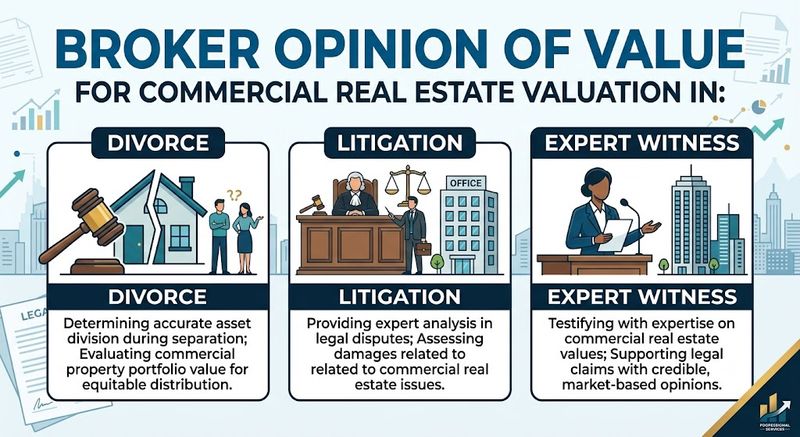
When Commercial Real Estate Valuation Matters in Legal Proceedings
Divorce and Marital Dissolution
Commercial property held as marital property must be valued to determine what each spouse receives in a settlement. The valuation establishes a buy-out price if one spouse keeps the property, or determines the fair division of proceeds if the property is sold. In contested divorces where both parties retain their own experts, competing opinions of value can differ substantially based on cap rate selection, income normalization, and comparable sales judgment. A BOV from a broker with active deal flow in the property type and market provides the market-participant perspective that a theoretical appraisal may miss.
For divorce proceedings, the distinction between a BOV and a certified appraisal matters. Most family law courts accept broker opinions of value as evidence of market value, particularly when the broker is qualified as an expert witness. A BOV costs less and delivers faster than a full USPAP-compliant appraisal, making it practical for the early stages of settlement negotiations. If the case proceeds to trial and expert testimony is required, the BOV can form the basis of that testimony.
Partnership Disputes and Business Dissolution
When co-owners of commercial real estate disagree about value, the right sale price, or whether to sell at all, an independent broker opinion of value gives all parties a market-based reference point that neither side can claim is biased toward the other. Partnership buyouts, forced sales, and partition actions all require a defensible property valuation as a starting point. A BOV from a credentialed commercial broker with comparable transaction experience provides that foundation.
Expert Witness Testimony
A licensed commercial real estate broker with documented transaction experience in the relevant asset class can be qualified as an expert witness in legal proceedings involving property value. Unlike a theoretical academic or a generalist appraiser, a broker who has personally negotiated the sale of comparable properties carries the market-participant credibility that courts find compelling. Expert witness services from a commercial broker typically cover:
- Opinion of market value as of a specific date, supported by comparable sales analysis
- Explanation of the income approach, cap rate derivation, and NOI normalization for income-producing properties
- Commentary on local submarket conditions, buyer demand, and what motivates buyers in the relevant property category
- Rebuttal of opposing party’s valuation methodology or comparable selection
- Deposition preparation and courtroom testimony on valuation methodology
Eminent Domain and Condemnation
When a government entity takes commercial property through eminent domain, the property owner is entitled to just compensation equal to fair market value. Government appraisals frequently understate value by using inappropriate comparables, outdated data, or misapplied cap rates. An independent BOV from a broker with comparable transaction experience in the property type and market gives the property owner and their attorney a documented market-based counter-position from which to negotiate or litigate for a higher award.

How Commercial Property Is Valued in Divorce and Litigation
The Income Approach: The Dominant Method for Income-Producing Property
For multifamily buildings, office properties, retail centers, industrial buildings, NNN assets, and most other income-producing commercial real estate, the income approach is the primary valuation methodology in both market transactions and legal proceedings. The income approach takes the property’s net operating income (NOI) and divides it by a market capitalization rate (cap rate) to produce an indicated value.
The cap rate is where litigation typically becomes contentious. A seemingly small difference in the cap rate applied to the same NOI produces a large difference in indicated value. A 5% cap rate applied to $500,000 NOI produces a value of $10 million. A 6% cap rate applied to the same $500,000 NOI produces approximately $8.3 million. The broker or appraiser who knows what buyers are actually paying for comparable assets in the current market is better positioned to support a specific cap rate than someone who has not recently transacted in that market.
The Sales Comparison Approach: Market Evidence
The sales comparison approach measures your property’s value against recent sales of comparable properties in the same market, adjusted for differences in size, location, condition, and lease structure. For some property types including development sites, owner-user buildings, and specialty assets, sales comparison is the primary method. For income-producing properties, it serves as a critical check on the income approach.
In litigation, comparable selection is often the most contested aspect of a valuation. Which sales are truly comparable? Were the transaction conditions arm’s-length? Did the buyer have a 1031 deadline? Did the seller accept below-market due to financial distress? A broker with active deal flow in the relevant market has direct knowledge of the circumstances behind comparable transactions that a generalist simply does not have.
What to Expect from the BOV Process for Litigation Support
When you request a BOV for litigation support, the process is confidential, professional, and documented. After you submit the property details and describe the legal context, a licensed broker will follow up to confirm the information needed and discuss the scope of the engagement. The broker will typically need:
- Property address, type, and total square footage or unit count
- Legal context: divorce, partnership dispute, eminent domain, litigation, or other
- Effective date of valuation if different from the current date
- Current lease information including rent roll, tenant names, and lease expiration dates
- Annual operating income and expenses for income-producing properties
- Any known factors affecting value: pending litigation, deferred maintenance, regulatory issues, or lease events
- Whether expert witness services or deposition preparation may be needed in addition to the written BOV
All communications and work product are handled with strict confidentiality. The BOV is prepared as of the specified effective date and delivered as a written document with the methodology, comparable sales analysis, and value conclusion documented for use in negotiations, mediation, or court proceedings.
Request a BOV for Divorce, Litigation, or Expert Witness Support
Attorneys, parties, and property owners may submit requests directly. All requests are handled confidentially. A licensed commercial real estate broker will review your request and follow up promptly to discuss the engagement.

Frequently Asked Questions
Can a broker testify as an expert witness on commercial property value in divorce court?
Yes. A licensed commercial real estate broker with documented transaction experience in the relevant property type and market can be qualified as an expert witness in family law and civil proceedings involving commercial property value. Courts have consistently accepted broker testimony on property value when the broker is properly qualified and their methodology is supported by market data.
Is a BOV or a certified appraisal better for divorce proceedings?
Both can be appropriate depending on the case. A BOV is faster and lower cost, making it practical for settlement negotiations and early-stage case preparation. A certified appraisal carries more formal authority and may be preferred or required in contested cases that proceed to trial. Many attorneys use a BOV to establish a negotiating position and commission a certified appraisal only if the case cannot be resolved at the negotiation stage.
Why do opposing experts often produce different values for the same commercial property?
Commercial property valuation involves significant professional judgment at every step: which comparables are truly comparable, what NOI is achievable under normal management, what cap rate the market is applying to this specific asset type and location, and how to adjust for property-specific factors. Each of these judgment calls can produce meaningfully different numbers when applied by different experts with different data sets and different market perspectives.
Can you prepare a BOV for a commercial property in any state?
Yes. We work with licensed commercial real estate brokers who are active in markets across the United States. Property type and submarket specialization is matched to the specific asset. Geographic and asset-class match matters for defensibility in litigation.