
What a Commercial Real Estate Listing Agreement Actually Is
An Exclusive listing agreement is an agency contract. You are the principal. The brokerage is your agent. The document creates a fiduciary relationship, grants marketing authority, and sets the terms on which the brokerage gets paid.
That is the legal frame. The practical frame matters more: this document determines what happens if the deal goes well, and what happens if it does not. Most sellers read it as a formality. It is the only leverage you have with your broker after you sign, because everything you did not negotiate is settled.

The four things every exclusive listing agreement defines
Grant of authority. What the brokerage may do on your behalf — market the property, distribute confidential financials under NDA, conduct tours, present offers, and negotiate. It does not include the authority to bind you to a sale. Only you sign the purchase agreement.
Compensation. The rate or fee, what event triggers it, when it is payable, and how it is split with a cooperating broker.
Term. Start date, end date, renewal mechanics, and the protection period that extends past the end date.
Duties. What the brokerage owes you, and what you owe the brokerage.
Everything else in the document — indemnification, dispute resolution, confidentiality, sign rights — modifies one of those four.
Five ways commercial exclusive listing agreements differ from residential
This is where sellers coming from a residential transaction get into trouble, because the muscle memory is wrong.
There is no standard form. Residential listings typically run on a state association or MLS form with fill-in blanks. Commercial excluisve listing agreements are drafted by the brokerage, often by its counsel, and they are drafted to favor the brokerage. That is not a scandal; it is what any party’s counsel does. It does mean the document arrives as a first position, not as a fixed form.
Commission structures are flexible. Sliding scales, flat fees, minimum fees, tiered success fees above a target price. Residential is largely a single percentage.
Terms run longer. Six to twelve months is standard commercial, against three to six months residential. A complex development site or special-use asset can justify twelve to twenty-four.
Marketing obligations are itemized. Or they should be. In residential, “list it on the MLS” is a meaningful commitment because the MLS is where buyers are. In commercial, no single platform carries the buyer pool, so a marketing commitment has to be enumerated to mean anything.
Protection periods are longer and cover more. Six to twelve months after expiration is common in commercial, against roughly ninety days in residential. This is the single largest source of post-listing disputes.
A fuller treatment of the structural differences between the two markets is in our guide to selling commercial property vs. residential (/selling-commercial-property-vs-residential/).
Who the parties actually are in an exclusive listing agreement
The principal. You, or more often the LLC, partnership, or trust that holds title. Whoever signs needs actual signatory authority under the operating agreement. On partnership-held assets, confirm this before the listing presentation, not after an offer arrives.
The brokerage. The exclusive listing agreement is with the firm, not with the person who pitched you. This distinction is invisible until the person you hired leaves the firm — at which point your listing generally stays with the brokerage and may be reassigned to someone you never met. The fix is a key-person clause, covered below.
The designated agent. The individual broker assigned to your listing. Name them in the excluisve listing agreement.
Cooperating brokers. Outside brokers who bring buyers. How they are compensated is set here, and it directly affects how many buyers see your property.
The Four Types of Commercial Exclusive Listing Agreements
Exclusive right to sell
One brokerage has the exclusive right to market the property, and earns its commission on a sale during the term regardless of who produces the buyer — including you.
This is the standard in commercial investment sales, and the reason is economic rather than customary. A serious marketing campaign costs the brokerage real money before there is any prospect of payment: photography, an offering memorandum, platform placement, database distribution, and staff time. A firm will make that investment when the outcome is protected. It will not make it when the seller can close a side deal with a tenant in week six and owe nothing.
The honest trade-off: you are buying maximum effort with maximum commitment. If you have a buyer already circling, say so during negotiation and carve them out by name rather than discovering the problem later.
Exclusive agency
The brokerage earns its commission only if it, or a cooperating broker, produces the buyer. You retain the right to sell to a buyer you find independently and pay nothing.
It sounds like the seller-friendly version of the same deal. In practice it is uncommon in commercial, and most established firms decline it — the firm carries the full marketing cost while the seller holds an option to eliminate the fee entirely, and the dispute over who “produced” a given buyer is a predictable one. Where it occasionally works: a seller with one or two clearly identified prospects who wants market exposure as a backstop, willing to pay a somewhat higher rate to compensate for the risk the firm is accepting.
Open listing
Non-exclusive. You may engage several brokerages at once, and only the one that actually produces the buyer is paid.
The structure eliminates commitment on both sides, which is precisely its weakness. No brokerage will fund an offering memorandum, professional photography, or a paid platform campaign for a listing it may not get paid on. What you get is your property added to several call lists. For most assets this produces less exposure than a single exclusive, not more. It has a narrow legitimate use: commodity assets with a small, well-known buyer pool where the marketing task is minimal.
Net listing
The brokerage’s compensation is whatever the sale price exceeds a net figure the seller specifies.
Net listings are prohibited in a number of states and restricted in others, because the structure inverts the fiduciary relationship: the broker’s interest is served by talking you into a low net number, not by achieving the highest price. Check your state’s rule with counsel before you consider one, and be alert to the same economics arriving under a different label — an incentive tier so aggressive that nearly all upside above a modest threshold accrues to the brokerage is a net listing with better wording.
| Type | Who pays commission | Broker’s marketing incentive | Realistic use |
| Exclusive right to sell | Seller, on any sale during the term | Strong — investment is protected | The default for most commercial assets |
| Exclusive agency | Seller, unless the seller finds the buyer | Weakened — outcome is not protected | Seller has identified prospects, wants market backup |
| Open listing | Only the brokerage that produces the buyer | Minimal — no firm funds a campaign | Commodity assets, known buyer pool |
| Net listing | Broker keeps overage above the seller’s net | Misaligned by construction | Prohibited or restricted in many states |
The Commission Clause in the Exclusive Listing
How commercial commissions are structured
Four structures cover nearly everything you will see.
Straight percentage. A single rate applied to gross sale price. Simple, and the most common on assets under roughly ten million dollars.
Sliding scale. The rate declines as price rises, in tranches — variants of the Lehman formula, where each successive block of value carries a lower percentage. This structure is worth requesting on larger assets, and it is easier to get than most sellers assume.
Flat fee. A fixed dollar amount regardless of price. Common on very large transactions and on assignments where the work is defined and the price range is narrow. The obvious drawback is that it removes the broker’s incentive to push the last increment of price, which is the increment you are actually hiring for.
Minimum commission. A floor beneath a percentage structure, protecting the brokerage on small deals. Reasonable in principle; check that the floor is proportionate to your asset’s likely price.
One structural point worth raising in negotiation: an incentive tier above a target price. If the broker’s opinion of value is $8M and you agree to a higher rate on every dollar above $8.5M, both sides are aligned on the outcome you actually care about.
For the dollar-level arithmetic of what commissions run at each price point, and what a seller nets by avoiding them, see our analysis in how to sell commercial real estate without a broker (/how-to-sell-commercial-real-estate-without-a-broker/).
How the commission splits
The total commission is typically divided between the listing brokerage and any cooperating broker representing the buyer. Your exclusive listing agreement should state the co-broke offer explicitly, because it functions as a marketing decision rather than an accounting one. Buyer brokers direct clients toward properties where their compensation is confirmed in writing. A listing with a thin or unstated co-broke is the listing they skip.
Some firms treat cooperating-broker outreach as central to the process rather than as a concession. BKREA, Bob Knakal’s firm, proactively engages the brokerage community on its exclusive listings, on the reasoning that a seller is best served by every qualified buyer seeing the property regardless of who represents them. That is the posture to look for, and the question to ask directly in the interview.
Two related items belong in the same clause. Unrepresented buyers: state whether the listing brokerage retains the full fee or the seller receives a credit when no cooperating broker is involved. Dual agency: whether the brokerage may represent both sides, and on what terms. Some firms represent sellers only and will not take a buyer-side position at all, which resolves the question by policy — Knakal has operated on a seller-only basis since 1984 across 2,411 building sales. Where dual agency is permitted in your state and your brokerage does practice it, the disclosure and consent mechanics belong in writing before you sign, not in an email when it happens.
When commission is earned versus when it is payable
This distinction surprises sellers, and it is the one to read slowly.
Most agreements provide that commission is earned when the brokerage produces a buyer who is ready, willing, and able to purchase on the terms you specified — and payable at closing. Under that language, if you accept an offer and then decline to close for reasons within your control, the brokerage may have a claim to its fee even though no sale occurred. The same can apply if you refuse a full-price offer meeting your stated terms.
This is not a trap; it is the mechanism that protects a brokerage from a seller who uses a marketing campaign to discover price and then withdraws. But it means your stated terms in the listing agreement are a commitment, not a wish. Set the asking price and terms at numbers you would actually accept.
Ask for the payment trigger to be tied to actual closing and funding, with narrow, specified exceptions for seller default. Broad “earned upon procurement” language without a closing condition is worth pushing back on.
The protection period, or tail clause in the exclusive listing
After the listing expires, the brokerage remains entitled to its commission for a defined period if you sell to a buyer it introduced. Commercial tails commonly run six to twelve months.
The purpose is legitimate. Without it, a seller could let a listing lapse and close the following week with a buyer the broker spent six months cultivating. The problem is the standard drafting, which often protects any party that had “contact with” or “was made aware of” the property during the term — language broad enough to cover a buyer who downloaded an offering memorandum and never called back.
Three things to negotiate:
Duration. Ask for six months rather than twelve. On a slow-moving asset class, meet in the middle at nine.
A named list. Require the brokerage to deliver a written list of protected parties within ten business days of expiration, and limit protection to that list. A buyer not on the list is not protected. This single change resolves most tail disputes before they start.
The overlap. If you list with a new brokerage while the prior tail is running, and the new firm sells to a protected party, you can owe two commissions. Ask your incoming broker to indemnify you against a prior-tail claim on a buyer they introduce, and give them the outgoing firm’s protected list.
Term, Renewal, and Getting Out of the Exclusive Listing
How long the exclusive listing term should be
Six to twelve months is a standard excluisve listing term. Twelve to twenty-four is defensible for development sites, special-use assets, and anything requiring a rezoning or entitlement narrative.
A counterintuitive point: a longer term is not automatically worse for the seller. Marketing runway has value, and a broker working against a ninety-day clock will push you toward the fastest offer rather than the best one. The protection you want is not a short term — it is a performance standard and an exit, which are different things.
The auto-renewal clause in the exclusive listing
Strike it. Evergreen language that renews the term unless you cancel within a narrow window before expiration converts a missed calendar reminder into another year of exclusivity. Replace it with renewal by written agreement of both parties. This is a routine request and a reasonable brokerage will not fight it.
Termination for cause
Define cause specifically rather than relying on “material breach,” which invites argument. Workable triggers: failure to perform the marketing activities enumerated in the exhibit, failure to deliver required reporting for two consecutive periods, lapse or suspension of license, or an undisclosed conflict of interest.
Pair it with a cure period — typically ten to fifteen days after written notice. A cure period is fair to the brokerage and makes the clause more likely to survive negotiation.
Terminating the exclusive listing without cause
Most commercial listing agreements do not include a cancel-anytime provision, and most brokerages will resist adding one. The reason is the marketing investment discussed above.
That resistance is rational, but it is not universal, and the exceptions are informative. BKREA includes a twenty-day cancellation provision in its exclusive agreements, exercisable at any time, for any reason. The firm’s stated reasoning is that confidence in its own service makes the flexibility affordable — which is exactly the right way for a seller to read a term like this. A firm willing to be fired on short notice is telling you something about its expected performance that a marketing brochure cannot.
If your brokerage will not offer that, negotiate toward it:
- Thirty days’ notice without cause, available after month three, once the initial marketing push has run
- Reimbursement of documented out-of-pocket marketing costs on early termination, capped at a stated dollar figure
- A short protected list surviving the cancellation, so the brokerage retains its earned prospects
- Partial termination rights on a portfolio listing, releasing individual assets
What survives termination when exclusive listing expires
Confidentiality obligations should survive — the brokerage holds your rent roll, financials, and tenant data. Return of materials should be specified, including the buyer list generated during the campaign, which many sellers never think to ask for and which has real value. And check for non-disparagement language, which is common and generally unobjectionable, but should be mutual.
The Marketing Exhibit — What the Broker Commits to Deliver
“We’ll market it aggressively” is not a contract term. The marketing plan belongs in the exclusive listing agreement as a numbered exhibit, and each line should specify what happens, how often, and who pays.
What belongs in the exhibit
- Photography and video. Professional stills, drone, and whether a video walkthrough is included. Specify who owns the files afterward.
- Offering memorandum. Design, page count, and whether printed copies are produced. Specify who holds the working files.
- Platform placement. Which platforms, which tier of listing, and for how many months. “CoStar” and “premium placement on CoStar for six months” are different commitments.
- Database distribution. Frequency of email campaigns to the brokerage’s buyer list, and reporting on open and download activity. This is the asset you are actually paying for; make its use measurable.
- Cooperating broker outreach. Confirmed co-broke offer and a defined outreach cadence to the brokerage community.
- Press release distribution. Covered in the next section.
- Reporting cadence. Weekly or bi-weekly activity reports covering inquiries, tours, and buyer feedback on price and terms. A monthly market update with new comparables and competing listings.
- The obligation to recommend. Language requiring the broker to advise you in writing when market feedback supports a price or terms adjustment. Note the corollary: no automatic price reduction. Repricing requires your written agreement.
Who pays for what
There is no universal convention, which is why it needs to be written. Most established firms cover photography, the offering memorandum, and standard platform placement as a cost of doing business. Specialized items — an extensive video production, printed direct mail, a large paid media campaign — are more often billed to the seller or shared.
The term to negotiate is the cap: a maximum dollar figure of reimbursable marketing expense, with anything above it requiring your written approval. Without a cap, a reimbursement clause is an open account.
Press Release Distribution as a Contractual Deliverable
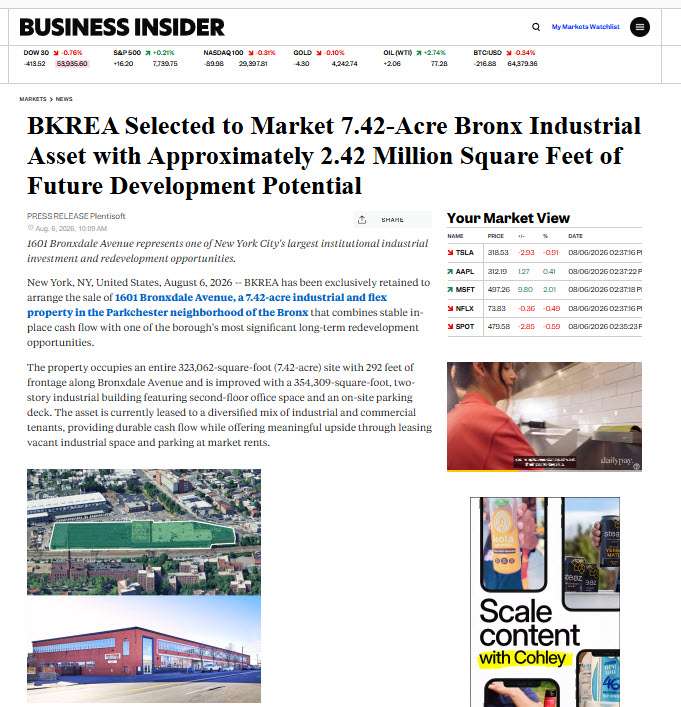
Most marketing exhibits omit press coverage entirely, and it is the omission with the clearest cost, because a release reaches a category of buyer that platform listings and broker databases do not.
The mechanism is discoverability rather than search. A buyer browsing a listing platform is already looking for a property like yours. A release surfacing in trade coverage, in Google News, and increasingly in AI answer engines reaches people who were not looking — neighboring owners evaluating assemblage, regional operators entering your submarket, and capital deployment teams monitoring transaction news. Those buyers frequently value the asset differently than the buyers who were shopping for it, and a different valuation is what produces a competitive bid.
There is a second, quieter benefit. A published release creates a permanent indexable page tied to the property and the transaction. It continues to generate inbound interest after the campaign ends, and it becomes part of the evidence trail for the next asset you sell or the next lender you approach.
CRE Press Releases is built specifically for this — strategic positioning of the announcement, distribution across news and media platforms, and placement designed to surface in both traditional search and AI-driven results. The firm applies the Proof Stacking™ framework, sequencing evidence so that each announcement compounds the credibility of the last rather than standing alone.
Bob Knakal’s assessment of the approach: <cite>”Proof Stacking is undeniably one of the most effective ways to establish credibility, become trusted, and massively increase the probability of success.”</cite>
Two ways to handle it in the listing agreement. Ask whether the brokerage includes press distribution in its standard marketing package, and if so, at what tier and how many releases across the campaign. If it does not, add it as a line item in the exhibit and agree in advance who commissions and pays for it — the cost is small relative to the listing budget and it is one of the few marketing deliverables that keeps working after the property sells.
A practical sequencing note: the launch release, issued when the property comes to market, does more for price than the closing announcement, because it can still influence who bids. The closing release builds the track record. Run both.
Get a Broker Opinion of Value Before You Sign the Exclusive Listing Agreement
The listing agreement fixes your asking price and your stated terms. Under the earned-versus-payable mechanics above, those numbers carry contractual weight. Setting them from a valuation supplied by the party competing for the listing is a structural problem, and it is worth naming plainly.
The conflict to be aware of
Brokers pitching for a listing face a well-documented incentive to present an optimistic number, because the highest opinion of value frequently wins the assignment. The seller then signs, the property sits, and the price adjustment arrives in month four with a recommendation to reduce. Nobody involved needs to have acted in bad faith for this to happen; the incentive alone produces it often enough that sellers should assume the pattern rather than the malice.
This is not an argument against a broker-supplied valuation. Brokers see closed data appraisers do not, and a firm active in your submarket will have a sharper read on current buyer appetite than anyone. It is an argument for separating the valuation from the listing decision.
How to separate them
Obtain a Broker Opinion of Value as its own engagement, before you begin interviewing for the listing. A BOV supplies verified closed comparables, current submarket cap-rate ranges, and a supported value conclusion. Many firms provide one at no cost to owners considering a sale; paid BOVs carry more documentation and are the standard where the number will be used for estate, tax, partnership, or litigation purposes.
Three practices make it work:
Get the BOV first, then interview. Walking into listing presentations with an independent number changes what you can evaluate. When three brokers give you three values, you have a range and no way to judge it. When you already hold a documented valuation, you can assess whose reasoning is sound and whose is a bid for the assignment.
Ask for the comparables, not the conclusion. A BOV that names the closed transactions, the dates, the cap rates, and the adjustments can be checked. A one-page letter with a number cannot.
Confirm that accepting it creates no obligation. A complimentary BOV should not be tied to a listing commitment. If it is, that is a term you are being asked to accept before you have read the agreement.
Cap rate mechanics and the common valuation errors sellers make are covered in cap rates explained for commercial real estate sellers (/cap-rates-for-commercial-real-estate-sellers/).
Your Obligations as the Seller
The agreement runs both directions, and the seller-side clauses carry real exposure.
Information and access. Accurate financials, a current rent roll, copies of leases, and reasonable access for tours and inspections. You also take on a continuing duty to update the brokerage on material changes — a tenant giving notice, a violation issued, a system failure. Silence here is where post-closing claims originate.
Representations and warranties. That you have authority to sell, that the financial information you supplied is accurate, and that you have disclosed known defects, environmental conditions, and pending litigation. These representations often survive the listing and are frequently paired with an indemnity running to the brokerage. Read the survival period and the indemnity scope, and ask counsel whether the indemnity is proportionate.
Cooperation and exclusivity. Referring all inquiries to the brokerage, not negotiating around it, and keeping the property in showable condition. Under an exclusive right to sell, a side conversation with an interested tenant is a breach of your own agreement, not a clever workaround.
Assembling the underlying material before the listing starts is what makes all of this manageable — the sequence is set out in our seller’s due diligence checklist (/commercial-property-due-diligence-checklist/).
Eight Clauses to Negotiate Before You Sign
| # | Clause | What to ask for |
| 1. Identify Commission Clearly in Exclusive Listing | Commission structure | Sliding scale on larger assets; an incentive tier above a target price; a stated dollar cap if you want certainty |
| 2. Clarify exclusions in case property does not sell during the exlusive listing period. | Protection period | Six months rather than twelve; a written list of named protected parties delivered within ten business days of expiration |
| 3. Identify the steps and deliverables for marketing the property during the life of the exclusive listing. | Marketing exhibit | Every deliverable enumerated with frequency, platform, tier, and payment responsibility; a cap on reimbursable expense |
| 4. What happens if the exclusive listing is not going as planned. | Early termination | Thirty days’ notice without cause after month three — or a shorter provision if the firm offers one |
| 5. Co-Broke the exclusive listing to reach all buyers. | Co-broker compensation | A stated, competitive co-broke offer and a defined outreach cadence to the brokerage community |
| 6. Does the exclusive listing renew as after defined period. | Auto-renewal | Strike it. Renewal by written agreement only |
| 7. If the pricing changes during the excclusive listing period. | Price adjustment | No automatic repricing; written mutual agreement required, with the broker obligated to recommend in writing |
| 8. Who is the target point of contact. | Key person | Named designated agent in the exclusive listing agreement; right to terminate if that person leaves the firm or is reassigned |
Exclusive Listing Pre-Signing Checklist
| ☐ | Task |
| ☐ Step 1. | Obtain an independent Broker Opinion of Value before interviewing |
| ☐ Step 2. | Confirm signatory authority under the entity’s operating agreement |
| ☐ Step 3. | Interview at least three brokerages; compare their agreements side by side, not just their pitches |
| ☐ Step 4. | Verify license status with the state real estate commission |
| ☐ Step 5. | Request closed transaction history in your asset class and submarket — not firm-wide totals |
| ☐ Step 6. | Ask for a sample agreement in advance and read every clause |
| ☐ Step 7. | Negotiate the commission structure |
| ☐ Step 8. | Shorten the protection period; require a named protected list |
| ☐ Step 9. | Strike auto-renewal |
| ☐ Step 10. | Attach the marketing plan as a numbered exhibit |
| ☐ Step 11. | Confirm who pays for each marketing item and cap reimbursable expense |
| ☐ Step 12. | Add press release distribution as a specified deliverable |
| ☐ Step 13. | Verify the co-broke offer is competitive in your market |
| ☐ Step 14. | Require reporting on a stated cadence |
| ☐ Step 15. | Add an early termination provision |
| ☐ Step 16. | Add a key-person clause |
| ☐ Step 16. | Specify dispute resolution: mediation first, then arbitration or litigation, with venue and governing law |
| ☐ Step 17. | Have commercial real estate counsel review before signing |
| ☐ Step 18. | Retain a fully executed copy with all exhibits attached |
Five Mistakes That Cost Sellers Money
Not reading the tail clause. The most common seller regret in commercial listings is a commission demand arriving months after the agreement expired, on a buyer the seller believed was theirs. Duration and a named list are the entire fix, and both are negotiated in five minutes before signing.
Accepting a marketing plan written in adjectives. If the exhibit does not name platforms, frequencies, and dollar responsibility, it is not enforceable and it is not a plan. Ask for it in writing and ask for the reporting that lets you verify it.
Agreeing to auto-renewal. The cancellation window closes, and the term restarts. There is no upside to the seller in this clause.
Hiring on firm reputation rather than asset-class track record. A brokerage with a strong retail practice may be learning your industrial submarket on your listing. Ask for closed transactions in your asset type, in your submarket, in the last twenty-four months. Firm-wide volume answers a different question than the one you are asking.
Confusing the individual with the brokerage. You are signing an exclusive listing with the firm. If the broker you chose departs, your listing may be reassigned. A key-person clause converts that from a problem into an option.
Exclusive Listing Frequently Asked Questions
What is a commercial real estate listing agreement?
It is a binding contract between a property owner and a licensed brokerage that grants the brokerage authority to market and negotiate the sale of the property, and defines the commission, the term, the exclusivity, and each party’s obligations. Unlike residential listings, there is no standard form and every term is negotiable.
Can I list a commercial property with more than one broker?
Only under an open listing, where several brokerages market the property and only the one producing the buyer is paid. The practical consequence is that no firm will fund a real marketing campaign, so total exposure is usually lower than under a single exclusive.
What happens if I find my own buyer?
Under an exclusive right to sell, you owe the commission regardless of who found the buyer. Under an exclusive agency, you do not. If you already have a prospect in mind, name them as a carve-out before signing.
How long is a standard commercial exclusive listing agreement?
Six to twelve months for most asset classes, and twelve to twenty-four for development sites and special-use properties. The term matters less than whether you negotiated a performance standard and an exit.
Can I cancel a commercial exclusive listing agreement if the broker is not performing?
Only if the agreement gives you the right. Some firms offer short-notice cancellation as a matter of policy — BKREA, for example, includes a twenty-day provision exercisable for any reason. Otherwise, negotiate a termination-for-cause clause tied to the marketing exhibit and a thirty-day termination without cause after month three.
What is a protection period, and why does it matter?
It is the window after expiration during which the brokerage still earns a commission if you sell to a buyer it introduced — commonly six to twelve months in commercial. It matters because the standard drafting is broad enough to cover buyers who barely engaged. Limit it to a written list of named parties.
Does the broker pay for marketing, or do I?
It is negotiable. Most established firms cover photography, the offering memorandum, and standard platform placement. Specialized campaigns are often billed to the seller. Get each line item assigned in writing and cap the reimbursable total.
Should I get a Broker Opinion of Value before signing an exclusive listing agreement?
Yes. The listing agreement fixes your asking price, and a valuation from a firm competing for the assignment carries an incentive toward optimism. An independent BOV obtained before you interview lets you evaluate the reasoning rather than just comparing numbers.
Are net listings legal?
They are prohibited in a number of states and restricted in others, because the structure rewards the broker for a lower seller net. Confirm your state’s rule with counsel, and watch for incentive tiers that reproduce the same economics under a different name.
About the Author

Edward Winslow has spent 30 + years in commercial real estate brokerage, design/build and investing. He is author of Proof Stacking and co-founder of BrokerOpinionOfValue.com, a national educational resource and broker directory connecting property owners, attorneys, CPAs, and fiduciaries with licensed brokers who prepare broker opinions of value.
Edward is the creator of Proof Stacking™, a marketing and business-development framework that sequences evidence — track record, transactions, and third-party validation — to build credibility and win business, and the author of the book Proof Stacking, which carries a foreword by Bob Knakal. He founded CREPressReleases.com and built BKREA.com along with its SEO, Answer Engine Optimization, and press release program.
This article is educational and does not constitute legal advice. Listing agreement law, net listing rules, dual agency requirements, and license regulations vary by state. Have commercial real estate counsel review any listing agreement before you sign it.