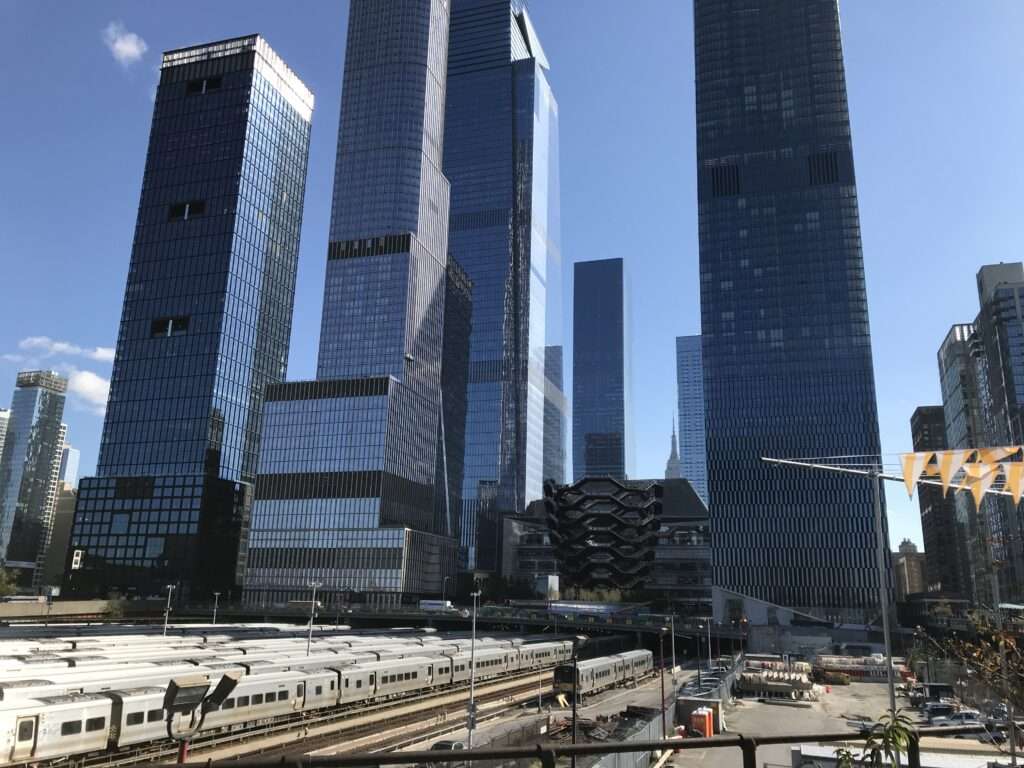
Air rights are the unused, zoning-permitted development capacity of a property — the difference between the maximum floor area a zoning lot is allowed and the floor area actually built. In New York City, that unused capacity can sometimes be sold or transferred to a nearby site, which makes it a real and separately valuable component of a commercial property’s worth.
The word “sometimes” carries most of the weight in that sentence. A property can hold 60,000 square feet of unused floor area on paper and have no buyer, no legal transfer path, and no value. Another property can hold 20,000 square feet and sell every foot of it. The difference is not the size of the inventory. It is whether a specific nearby project can legally receive the rights and profitably build with them.
This guide explains how unused development rights are calculated, how they are transferred in New York City, what changed under City of Yes for Housing Opportunity, and how a broker opinion of value should treat air rights in a sale, estate, tax, or litigation context.
What are air rights in commercial real estate?
Air rights are the real-property rights to use, control, or develop the space above a parcel of land. In commercial real estate practice, the term almost always refers to a site’s unused zoning floor area — not to unlimited ownership of the sky above the roof.
Zoning controls the size, height, and bulk of what can be built on a lot. When an existing building is smaller than what zoning permits, the gap is commonly called unused development rights, excess FAR, or air rights. Subject to local rules, an owner with that gap can generally do one of three things:
- Build an addition or a replacement project that uses the capacity on site.
- Sell or transfer the capacity to an eligible nearby lot.
- Preserve it — often through a recorded restriction — to protect light, views, or future redevelopment value.
Air rights vs. unused development rights vs. TDRs
These terms are used loosely in the market and precisely in the Zoning Resolution. The distinction matters in a valuation.
- Unused development rights is an inventory measurement. It is arithmetic: permitted floor area minus built floor area minus prior transfers.
- Transferable development rights (TDRs) are a subset of that inventory — the portion a specific zoning mechanism actually allows to move to another lot.
- Air rights is the market shorthand that covers both, plus a range of easements and volumetric interests that have nothing to do with FAR.
| A property’s unused development rights and its transferable development rights are rarely the same number. Treating them as identical is the most common error in owner-side air rights expectations. |
What air rights do not include
Owning unused development rights does not confer:
- A right to build to any height. FAR, height limits, setbacks, bulk controls, environmental review, and the building code all still apply.
- A right to overhang or obstruct a neighboring parcel without a valid easement or agreement.
- Any control over navigable airspace, which is federally regulated.
- An automatic right to transfer. Transfer authority is highly local and transaction-specific.
How do you calculate unused development rights?
The NYC Department of Buildings defines unused development rights as the difference between the maximum floor area permitted on a zoning lot and the floor area that has actually been built. Read about how to calculate unused development rights.
| Unused development rights = maximum permitted zoning floor area − existing zoning floor area − previously transferred floor area |
Worked example
Assume a 10,000-square-foot zoning lot in a district permitting 6.0 FAR:
| Line item | Zoning square feet |
| Maximum permitted floor area (10,000 sf × 6.0 FAR) | 60,000 |
| Existing two-story building | 20,000 |
| Prior transfers of record | 0 |
| Unused development rights | 40,000 |
That 40,000 square feet is an inventory number. It is the starting point of an analysis, not the answer to it.
Why zoning floor area is not assessor square footage
Zoning floor area is a defined measurement under the Zoning Resolution. It is not the gross building area on a tax record, not the rentable area in a lease abstract, and not the number on a listing. Cellar space, mechanical space, and certain other areas may be excluded; other areas may be included that an owner would not intuitively count.
Any credible air rights analysis begins with a zoning floor area calculation by an architect or zoning consultant, plus a title and zoning-lot history review. Screening from public data is appropriate for prospecting. It is not appropriate for pricing.
How much are air rights worth in NYC?
There is no citywide price for air rights. Value is set almost entirely by what a specific receiving site can do with the incremental floor area.
The buyer of development rights is not acquiring a view or a volume of sky. The buyer is acquiring the legal ability to build additional square footage on a project it already controls. What it will pay is a function of the residual value of that additional square footage:
| Value of the rights ≈ (revenue from the incremental floor area) − (hard costs + soft costs + financing + carrying costs + profit requirement) on that same increment |
This is why air rights are quoted in dollars per buildable square foot rather than as a lump sum, and why the same 40,000 square feet can be worth a great deal on one block and nothing on the next.
What drives price per buildable square foot
- Receiving-site product economics. Projected sellout or stabilized NOI from the added floor area in that submarket.
- Physical deployability. Whether the added FAR can actually be built after height and setback rules, tower coverage, lot coverage, light and air, dwelling unit factor, loading, and parking requirements. Floor area that cannot be efficiently configured is worth less than floor area that can.
- Competition among sources. Whether the receiving developer has one candidate grantor or four.
- Timing and process risk. A certification is faster and more predictable than a special permit. Process risk is priced.
- Regulatory obligations attached to the increment, including inclusionary housing requirements where applicable.
Development rights commonly trade at a discount to fee-simple land in the same submarket on a per-buildable-square-foot basis, because the buyer receives density without receiving a site, and because the transfer carries process and documentation risk. The size of that discount is a market question that has to be answered with current comparable transfers — not with a rule of thumb.
The cap that surprises owners
Consider the 40,000-square-foot inventory above, held by an individual landmark. Assume the most logical receiving lot has a maximum permitted floor area of 100,000 zoning square feet.
Under the landmark transfer certification, that receiving lot can generally accept an increase of 20 percent — 20,000 square feet. The owner’s 40,000-square-foot inventory does not have one buyer. It has, at best, two, and the second one may not exist.
| A valuation that multiplies 40,000 square feet by a market rate per buildable square foot will overstate the asset, sometimes by half. |
How can air rights be transferred in New York City?
There are four principal pathways. Identifying the correct one is the first substantive step in any air rights assignment, because each carries different geography, approval process, caps, and cost.
Zoning lot merger
What is a zoning lot merger? The most common route for ordinary, non-landmarked property.
Two or more adjoining tax lots are treated as a single zoning lot for zoning purposes. The combined lot’s permitted floor area can then be allocated across it, allowing the developer to place more of that floor area on its parcel. Ownership stays separate; recorded zoning-lot documents govern the allocation, and the source parcel permanently gives up the floor area allocated elsewhere.
A zoning lot is not the same as a tax lot. A zoning lot may comprise multiple tax lots under separate ownership. That distinction is what makes the merger an as-of-right density tool rather than a sale of land.
Landmark TDR under ZR 75-42
Landmark TDR under ZR 75-42 is available where the granting lot contains a designated New York City landmark building or structure. Cemeteries, statues, monuments, and bridges are excluded from the program.
The transfer moves a defined amount of unused floor area from the landmark granting lot to a qualifying receiving lot within a defined surrounding area. The granting and receiving owners apply jointly to the Chair of the City Planning Commission. The application includes zoning calculations and site plans for both sites, a continuing maintenance program for the landmark, and a report from the Landmarks Preservation Commission concerning that program.
Key limits
- The transferable base equals district-permitted floor area less existing floor area and prior transfers. Certain zoning bonuses are excluded from the transferable inventory.
- The certification route generally caps the receiving lot’s increase at 20 percent above its maximum permitted floor area. In commercial or manufacturing districts where the maximum non-residential FAR is 15.0 or greater, the cap is 30 percent.
- The transfer instrument and notices of restriction must be executed and recorded with the City Register before the Chair certifies compliance to the Department of Buildings.
- A separate certification filing is required for each independent receiving lot.
- The transfer is irrevocable. Once completed, the granting lot’s future development capacity is permanently reduced — even if the landmark designation is later removed, the structure is destroyed, or the site is redeveloped.
ZR 74-79 special permit
ZR 74-79 special permit is required for landmark transfers that exceed the 30 percent increment in qualifying high-density commercial or manufacturing districts, and for transfers requiring bulk relief beyond what the certification route accommodates. This is a discretionary City Planning Commission action rather than a ministerial one, with corresponding time, cost, and outcome risk.
Related: ZR 75-24 permits the Commission to authorize certain bulk modifications other than FAR in conjunction with a 75-42 transfer, with height modifications limited to a 25 percent increase over the applicable maximum.
Special district transfer programs
Certain special purpose districts establish their own transfer geography and procedures — including areas of Midtown and the Theater Subdistrict, East Midtown, Lower Manhattan, and Hudson Yards. Where a special district program applies, the Zoning Resolution text defines exactly which granting and receiving sites qualify. These mechanisms can move rights farther than a conventional merger, but only within the mapped district or designated subarea.
What did City of Yes change about landmark air rights?
City of Yes for Housing Opportunity, adopted December 5, 2024, materially changed the landmark development rights transfer program. It did not create a citywide air rights market.
What changed
- Expanded receiving geography. Transfers from an individual landmark may now reach any lot on the landmark’s tax block, lots across the street from that block, and lots at the next intersection — rather than being confined to immediately adjoining lots.
- Certification instead of ULURP. Many transfers that previously required a discretionary special permit subject to full public review can now proceed by City Planning Commission Chair certification, which is faster and more predictable.
- Broader eligibility. Individual landmarks located within historic districts became eligible to transfer development rights.
What did not change
| Question | Answer |
| Can a non-landmarked building transfer rights anywhere in NYC? | No. It still generally requires a zoning lot merger with an eligible adjoining site, or a special district program. |
| Can a landmark sell rights citywide? | No. Transfers remain confined to the defined surrounding area or an applicable special district program. |
| Can a receiving site add unlimited FAR? | No. The certification route caps the increase at 20 percent, or 30 percent in commercial and manufacturing districts with non-residential FAR of 15.0 or greater. |
| Is a special permit ever still required? | Yes — for transfers above the 30 percent increment in those districts, and where bulk relief beyond the authorization is needed. |
Why this matters commercially
The reform meaningfully widened the buyer pool for individually landmarked, underbuilt properties. Before, the practical buyer universe was often a single adjacent owner, which is not a market — it is a negotiation with one counterparty and no leverage. A block-wide and across-the-street receiving area can turn that into a competitive process, which is where price improvement comes from.
For non-landmarked property, the effect is indirect but real. City of Yes amended the citywide Zoning Resolution in ways that can change a source site’s permitted density, improve a receiving site’s ability to physically deploy added floor area, and alter the marginal value a developer assigns to purchased capacity. Any air rights study prepared on pre-December 2024 assumptions should be re-run.
Zoning lot merger vs. landmark TDR: which one applies?
| Issue | Zoning lot merger | Landmark TDR |
| Core concept | Adjoining zoning lots are joined into one, so FAR can be allocated across the combined site | Unused floor area moves from a landmark granting lot to a qualifying receiving lot |
| Landmark required | No | Yes — designated landmark building or structure |
| Location of sites | Generally adjoining, commonly on the same block | Receiving lot must be in the defined surrounding area |
| Approval path | Usually as-of-right with proper documentation and DOB review | CPC Chair certification under ZR 75-42; special permit in defined cases |
| Density cap on receiver | No transfer-specific cap; the combined lot’s aggregate FAR governs | Generally 20 percent, or 30 percent in qualifying C/M districts |
| Effect on source | Capacity may be reallocated within the merged lot, subject to the recorded declaration | Transferred floor area is irrevocably removed |
| Underwriting character | Cleaner when parcels are contiguous and controllable together | Valuable when the source cannot be merged with the buyer’s site |
The practical rule: the label “air rights deal” is not enough to underwrite. Confirm whether the transaction is a zoning lot merger, a ZR 75-42 certification, a ZR 74-79 special permit, or a special district program, because the permitted geography, approval process, timing, and usable value differ substantially.
Which NYC properties have the most valuable unused air rights?
Any property can hold unused air rights if its existing zoning floor area is below the maximum permitted on its zoning lot. In practice, the strongest candidates are underbuilt properties in high-density districts.
Common candidate property types
- One- to four-story commercial buildings on avenues and major retail corridors where zoning supports substantially larger buildings.
- Older walk-up multifamily buildings in neighborhoods that were later upzoned.
- Single-story retail and bank buildings, including former pharmacies, fast-food sites, showrooms, and supermarkets.
- Parking garages and surface parking lots, which may carry little or no existing zoning floor area against a large permitted FAR.
- Warehouses, industrial buildings, and low-scale flex properties in rezoned or transitioning areas such as parts of Long Island City, Downtown Brooklyn, Gowanus, Williamsburg, and the Far West Side.
- Houses of worship — churches, synagogues, and religious schools — often low-density uses on comparatively large lots in strong development markets.
- Schools, community facilities, hospitals, and nonprofit-owned buildings that predate the current zoning envelope.
- Theaters, cultural institutions, and historic structures where preserving the existing building makes full on-site redevelopment impractical.
- Individually landmarked buildings with unused floor area and a qualifying receiving site.
- Large sites with multiple tax lots, where an underbuilt parcel can contribute capacity to a denser adjoining parcel.
The four factors that separate a candidate from a transaction
- Low existing FAR relative to the lot’s permitted maximum.
- A development location with residual value — a submarket where added residential, office, hotel, or mixed-use floor area is worth building.
- A legal transfer pathway — an adjoining buyer for a merger, or eligibility for a landmark or special district mechanism.
- A buildable receiving envelope — a developer that can physically use the added FAR after all bulk constraints.
A two-story building in a 10-FAR district is a far stronger candidate than a twelve-story building on a comparable lot. But the first three factors can all be present and the deal can still fail on the fourth.
Why unused FAR does not always sell
Owners are frequently told a number and hear it as a price. These are the recurring reasons unused rights command nothing:
- No adjoining or otherwise eligible receiving site. The inventory exists; the geography does not.
- The neighbor already built. A nearby development has consumed its available FAR and has no use for more.
- The receiver cannot fit the density. Height, setback, lot coverage, and light-and-air constraints prevent the added floor area from becoming marketable product.
- Prior encumbrances. Zoning-lot declarations, earlier air rights sales, easements, or condominium documents have already restricted the property.
- The increment is too small. Legal, survey, zoning, and transaction costs consume the proceeds.
- The submarket does not support incremental development. Land and sellout economics do not clear.
An owner is better served by a clear negative early than by a marketing process built on an inventory number.
How do houses of worship sell air rights?
Religious institutions sell unused zoning floor area the same way other owners do. The institution is not selling airspace; it is monetizing the gap between its building’s existing zoning floor area and the maximum permitted on its zoning lot.
Two routes apply. Where the institution’s property and the developer’s site adjoin or can otherwise be combined, a zoning lot merger is typically the cleaner path: the parties sign an air rights purchase and sale agreement, record a zoning-lot declaration combining the parcels for zoning purposes, and the developer allocates part of the combined permitted floor area to its project. The institution’s property is left permanently restricted as to the allocated capacity.
Where the institution’s building is an individual landmark, the ZR 75-42 route may apply instead, with the joint certification application, the continuing maintenance program, the LPC report, and the recorded transfer instrument and restrictions.
Two considerations specific to institutional sellers
- Governance. Religious corporations and nonprofits frequently require board, trustee, congregational, denominational, lender, or court-related approvals before a sale can close. This should be mapped at the outset, not discovered at contract.
- Use of proceeds. Proceeds are commonly applied to capital repairs, restoration, endowment, debt reduction, or mission purposes, subject to governing documents and applicable nonprofit law. In landmark transfers, proceeds are often placed in an endowment whose income funds the required continuing maintenance.
Can air rights be sold anywhere in NYC?
No. This is the single most persistent misconception in the market.
| Situation | Can rights move to a non-adjoining property? |
| Typical non-landmarked building | Usually no — evaluate a zoning lot merger with an adjoining property |
| Individually landmarked building | Yes, but only to a qualified receiving lot in the defined surrounding area |
| Property in a special TDR district | Potentially, but only as that district’s zoning text allows |
| Any building to any NYC neighborhood | No |
A low-rise retail building in Chelsea cannot sell its unused FAR to a tower site in Long Island City. Identify the legal transfer path first, then search only within its permitted geography. A prospect list built citywide will overstate what is marketable.
What does an air rights transaction look like start to finish?
- Zoning due diligence. Confirm current zoning, permitted FAR, existing zoning floor area, zoning-lot history, special district overlays, landmark status, prior transfers, and recorded restrictive declarations.
- Establish eligibility. Identify the exact transfer authority and confirm that both parties satisfy the location, use, contiguity, and cap requirements.
- Underwrite receiving-site utility. Determine how much of the incremental FAR the buyer can actually build after height and setback, tower coverage, dwelling unit factor, loading, parking, affordability, and code constraints. Nominal square footage and usable square footage are different assets.
- Price the rights. Negotiate per transferred or usable zoning square foot, against the receiving project’s residual — not against the grantor’s nominal inventory.
- Contract and document. Purchase and sale agreement, transfer instrument, zoning-lot declaration or notices of restriction, title work, survey, and any easements or access agreements.
- Approvals and recording. Certification, special permit, or as-of-right documentation as applicable; record the instruments; proceed to DOB filings and permits.
How air rights affect a broker opinion of value
For an underbuilt property in a high-density district, air rights are not a footnote. They can be the majority of the asset’s value, and they are the component most often stated wrong.
A broker opinion of value that addresses air rights should:
- Separate the three questions. Available zoning floor area, legally transferable floor area, and market value to a specific receiving site are three different findings. Reporting them as one number is where valuations go wrong.
- State air rights value as contingent until zoning counsel, a land use consultant, an architect, and a survey review confirm both the granting-site inventory and the receiving-site capacity. NYC zoning can permit an FAR transfer while bulk controls prevent the receiver from realizing it.
- Identify the transfer mechanism by name, and price only within its permitted geography.
- Apply the applicable increment cap per receiving lot, and note whether the full inventory requires more than one buyer.
- Support pricing with comparable development rights transfers, not with land comparables used uncritically as a proxy.
This matters most in the contexts where the number gets tested by someone else: estate and gift tax reporting, partnership buyouts, matrimonial and other litigation, tax certiorari, eminent domain, and pre-sale positioning. A well-documented, appropriately qualified opinion survives scrutiny. An inventory number multiplied by a market rate does not.
Frequently asked questions about NYC air rights
Can I sell my building’s air rights?
Possibly. It depends on whether your property has unused zoning floor area, whether a legal mechanism authorizes transferring it, and whether an eligible nearby site can use it. All three must be true.
How much are my air rights worth?
There is no citywide rate. Value derives from what a specific receiving developer can profitably build with the added floor area, expressed as a price per buildable square foot. Two properties with identical unused FAR on different blocks can be worth very different amounts, and one of them can be worth nothing.
How do I find out how much unused FAR my property has?
Start with lot area, current zoning, and permitted FAR to estimate maximum floor area, then subtract existing zoning floor area and any prior transfers. Confirm the result with an architect or zoning consultant using zoning floor area — not tax record square footage — together with a title and zoning-lot history review.
Can I sell development rights to my neighbor?
That is the most common structure. Where the parcels adjoin and can be treated as one zoning lot, a zoning lot merger allows the neighbor’s project to use floor area attributable to your parcel, with recorded documents permanently restricting your future use of it.
Is an air rights appraisal the same as a broker opinion of value?
No. An appraisal is a certified valuation prepared by a licensed appraiser under USPAP. A broker opinion of value is a written estimate of market value prepared by a licensed commercial broker, based on comparable transactions and current market conditions. A BOV is typically faster and less costly, and is used where a formal appraisal is not required. Some purposes — certain lending, litigation, and tax matters — require an appraisal.
Do air rights expire?
The unused capacity does not expire on a clock, but it is not permanent either. Rezoning can increase or reduce permitted floor area. Building on your own site consumes it. And once transferred, it is gone irrevocably — the granting lot’s future development capacity is reduced by that amount even if circumstances later change.
If I sell my air rights, can I still redevelop later?
Only up to the reduced capacity. The recorded restriction limits what can later be built on the granting lot. This is why a sale should be evaluated against the property’s own long-term redevelopment plan, not just against the check.
What is price per buildable square foot?
The unit convention for pricing development rights: total consideration divided by the number of transferable zoning square feet. It allows comparison against land sales and other transfers in the same submarket — provided the comparison accounts for whether the floor area can actually be built.
Get a broker opinion of value for a property with unused development rights
BrokerOpinionOfValue.com connects commercial property owners, attorneys, CPAs, executors, and fiduciaries with licensed commercial real estate brokers who prepare broker opinions of value. If your property is underbuilt relative to its zoning — or you are evaluating an offer for development rights — a broker who works in your submarket can tell you what the capacity is worth to the buyers who can actually use it.